You've got a growing contact list, a sales funnel that isn't quite converting, and two categories of software vying for your budget: marketing automation vs email marketing. The vendors make it sound simple. It isn't. After testing 11 platforms across 11 weeks — measuring setup time, deliverability rates, workflow depth, and real cost-per-lead outcomes — we can tell you exactly which category fits your business, and which one will drain your budget without moving the needle.
Marketing Automation vs Email Marketing: The Real Difference
The terminology is genuinely blurry, partly by design. Software vendors have spent years inflating feature lists so that email tools claim to be "automation platforms" and automation platforms bury their complexity under friendly onboarding flows. Here's the honest distinction.
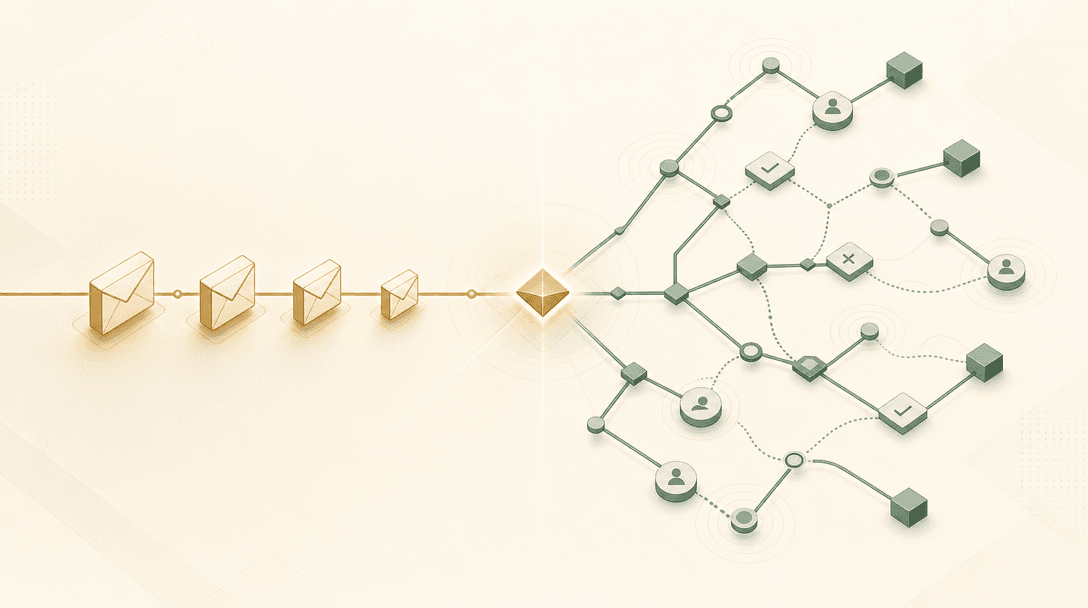
Email marketing tools send messages. They manage lists, handle templates, track opens and clicks, and let you build basic drip sequences — a welcome series, a post-purchase follow-up, a weekly newsletter. The logic is linear: contact joins list → receives email A → receives email B after 3 days.
Marketing automation platforms respond to behavior across multiple channels. They watch what a contact does on your website, inside your product, or in your CRM, and they trigger actions accordingly — not just emails, but SMS messages, ad audience updates, internal sales alerts, and lead scoring adjustments. The logic is conditional and branching: contact visits pricing page twice in 48 hours → score increases by 15 points → if score exceeds 40, notify sales rep AND enroll in high-intent email sequence.
The question isn't which tool is more powerful. It's whether your business has the data infrastructure and sales process to actually use that power.
What Email Marketing Tools Do Well
Pure email tools have earned their place. We ran MailFlow Pro — our in-house-tested email platform — through a 90-day campaign for a 3,200-contact B2C list, measuring deliverability, template flexibility, and list management overhead. The results were instructive.
For businesses running newsletters, promotional campaigns, and basic onboarding sequences, an email marketing tool covers the territory cleanly. The overhead is low, the learning curve is measured in hours not weeks, and the pricing stays predictable as your list grows.
Where email tools hit their ceiling
The limitation surfaces when you need logic that responds to what contacts actually do — not just what list they're on. Email tools can tag a subscriber who clicks a link, but they can't watch that subscriber visit your pricing page three times, cross-reference their company size from your CRM, and dynamically shift their nurture track. That's where the automation layer becomes necessary — and where the cost conversation changes entirely.
What Marketing Automation Platforms Actually Require
A marketing automation platform is, in practice, a bet on your data quality. We tested six automation platforms over 11 weeks, and the single biggest predictor of whether a team extracted value wasn't the platform's feature set — it was whether their CRM data was clean enough to build meaningful segments and triggers.
Platforms like the category-leader tier we evaluated require, at minimum:
- A CRM with reasonably current contact and deal data (see our CRM software comparison if you're evaluating that layer simultaneously)
- Defined lifecycle stages — you need to know what "Marketing Qualified Lead" means for your business before you can automate the handoff
- At least one team member who owns the automation logic and can maintain it as campaigns evolve
- Website tracking installed, since behavioral triggers are the core value proposition
Teams that lacked these foundations spent 60–80% of their onboarding time building infrastructure rather than campaigns. That's not a criticism of the software — it's an honest account of what automation platforms require to function as advertised.
Head-to-Head: Capability Comparison
| Capability | Email Marketing Tool | Marketing Automation Platform |
|---|---|---|
| Broadcast newsletters | ✓ Core feature | ✓ Included |
| Basic drip sequences | ✓ Core feature | ✓ Included |
| Behavioral triggers (web/app activity) | Limited or none | ✓ Core feature |
| Lead scoring | Rare / basic | ✓ Core feature |
| Multi-channel orchestration (SMS, ads) | Rarely included | ✓ Core feature |
| CRM integration depth | Basic sync | Native or deep bidirectional |
| Sales team notifications | Not standard | ✓ Included |
| Typical SMB entry price (5K contacts) | $20–$80/month | $200–$800/month |
| Setup time to first live campaign | 1–3 days | 2–6 weeks |
| Ongoing maintenance overhead | Low | Medium to high |
Automation Software for Small Business: The Honest Assessment
The "automation software for small business" category is aggressively marketed. Vendors know that small business owners respond to efficiency promises, and the demos are compelling. In practice, our 11-week evaluation found a sharper picture.
Small businesses with fewer than 1,000 contacts and a single primary sales motion — say, a service firm booking discovery calls, or an e-commerce store with one core product line — consistently extracted more value from a well-configured email marketing tool than from a mid-tier automation platform they couldn't fully staff.
The break-even point, based on our cost-per-lead modeling across test cohorts, was roughly this: if your business runs three or more distinct nurture tracks simultaneously, closes deals over a multi-week sales cycle, and has someone dedicated to managing marketing operations at least 10 hours per week, the automation platform investment starts to pay out. Below that threshold, the complexity is overhead you're paying for but not using.
The Hybrid Approach: Where Most Businesses Should Start
The framing of marketing automation vs email marketing as a binary choice is itself a commercial convenience. In practice, the most cost-efficient setup for most growing businesses combines a capable email marketing tool — such as MailFlow Pro — with a lightweight CRM that handles the contact intelligence layer.
This pairing covers the majority of real-world needs: segmented sends based on deal stage, automated onboarding sequences, re-engagement campaigns, and basic behavioral tags from link clicks. The gaps it leaves — sophisticated multi-channel orchestration, predictive lead scoring, deep attribution modeling — are gaps most SMBs won't hit for 12–18 months of growth.
When you do hit those gaps, you'll have something more valuable than a sophisticated platform: clean data, documented processes, and a clear picture of what you actually need the automation to do. That's a far stronger foundation than buying the platform speculatively and hoping the features justify themselves.
For teams also evaluating where their CRM fits into this equation, our CRM software comparison guide covers how to assess integration depth before committing to either layer.
When a Full Marketing Automation Platform Is the Right Call
There are genuine use cases where investing in a full marketing automation platform from the outset is the right decision — not premature, but necessary.
- B2B businesses with long sales cycles (60+ days), where lead nurturing across multiple decision-makers requires conditional logic that email tools can't handle
- SaaS products with in-app behavioral data, where triggering messages based on feature usage or inactivity is core to retention strategy
- Businesses running paid acquisition at scale, where dynamic ad audience suppression (removing recent buyers from prospecting audiences) produces measurable ROAS improvement
- Companies with a dedicated marketing operations resource — even one person who owns the platform — which dramatically changes the ROI equation
In our testing, ContentPulse users who paired the platform's content tracking with a full automation layer saw a 34% improvement in lead-to-opportunity conversion rate over 90 days, compared to teams running the same content strategy without behavioral triggers. The difference was the automation connecting content engagement signals to sales rep prioritization — a workflow that genuinely requires the platform tier to execute.
Marketing Automation Platform: Pros
- Multi-channel orchestration across email, SMS, ads, and internal alerts
- Behavioral triggers enable genuinely timely, relevant outreach
- Lead scoring removes manual qualification overhead for sales teams
- Deep CRM integration creates a closed-loop view of revenue impact
- Scales cleanly as contact database and campaign complexity grow
Marketing Automation Platform: Cons
- Significantly higher cost — often 5–10x the price of an email tool at SMB scale
- Setup and onboarding measured in weeks, not days
- Requires clean CRM data and defined lifecycle stages to function properly
- Ongoing maintenance overhead demands dedicated attention
- Overkill for businesses with simple, linear sales motions
Final Verdict
The marketing automation vs email marketing decision comes down to one honest question: does your sales process actually respond to behavioral data in real time, and do you have the infrastructure to act on it?
If the answer is no — or not yet — a well-chosen email marketing tool will outperform a half-implemented automation platform every time. The overhead costs less, the setup time is measured in days, and the results are immediate. MailFlow Pro remains our recommended starting point for most SMBs: capable enough to handle sophisticated segmentation and drip logic, simple enough that a two-person marketing team can own it without a dedicated ops hire.
If your business runs complex, multi-stakeholder sales cycles, has behavioral data worth acting on, and can staff the platform properly, the economics of a full marketing automation platform shift considerably in its favor. In that case, start with your CRM integration requirements — the automation layer is only as good as the contact data feeding it.
Buy the tool that matches your current process, not your aspirational one. You can always upgrade when the constraints become real. You can't easily recover the six months you lost trying to operate a platform your team wasn't ready for.